Soil Dynamics: Expansive Clay & Pressure
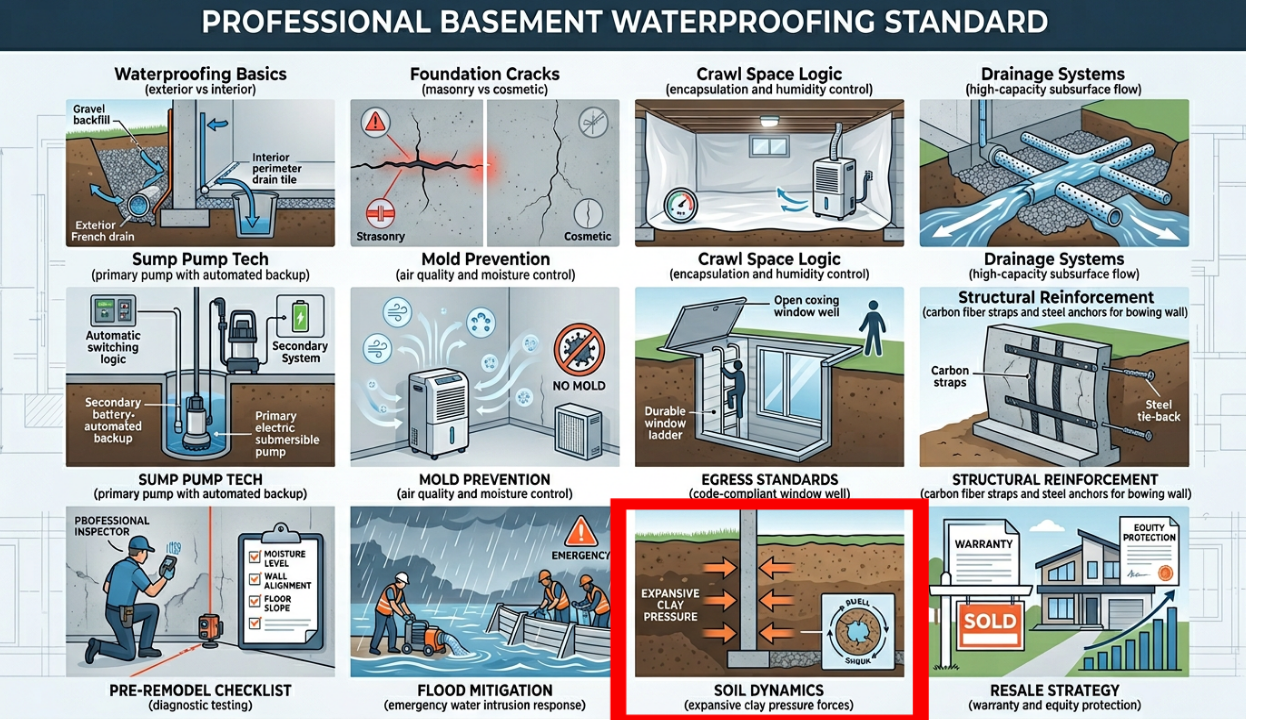
Foundation health begins with understanding Soil Dynamics—the movement and pressure exerted by the earth. Engineering solutions must account for expansive clay and the resulting hydrostatic pressure.
The Legacy “Static” Approach
Treating soil as an unchanging element leads to system failure when local conditions shift or heavy rains occur.
- ✗Ignoring Expansion: Assuming soil volume and weight remain constant year-round.
- ✗Generic Solutions: Applying identical drainage depth regardless of local clay porosity.
- ✗Passive Defense: Waiting for leaks to occur before addressing external pressure.
The Professional Standard
Design systems that proactively "bleed off" water weight before it reaches structural limits or forces its way through masonry.
- ✓Hydrostatic Relief: Creating a superior path of resistance to guide water away.
- ✓Saturation Management: Utilizing specific aggregates to improve drainage speed.
- ✓Lateral Load Mitigation: Neutralizing the "push and pull" cycle of expansive red clay.
The Physics of Foundation Pressure
Your foundation is under constant attack from the physics of the earth. When soil becomes saturated, it expands and exerts thousands of pounds of Lateral Load against your masonry walls.
Clay vs. Sand Dynamics
Expansive clay soils act like a sponge, holding water and increasing significantly in volume. This creates a cycle of structural stress that leads to cracking and bowing. Professional analysis is designed to counteract these specific behaviors.
The Hydraulic Pressure Standard
Water always takes the path of least resistance. Professional waterproofing doesn't just "block" water; it creates an engineered drainage path that guides water away before it can build enough pressure to penetrate the masonry.