Mold Prevention: Air Quality & Moisture Control
The professional standard for mold prevention is defined by Relative Humidity (RH) control and structural decoupling. Permanent solutions require removing the environmental conditions that allow microbial life to thrive.
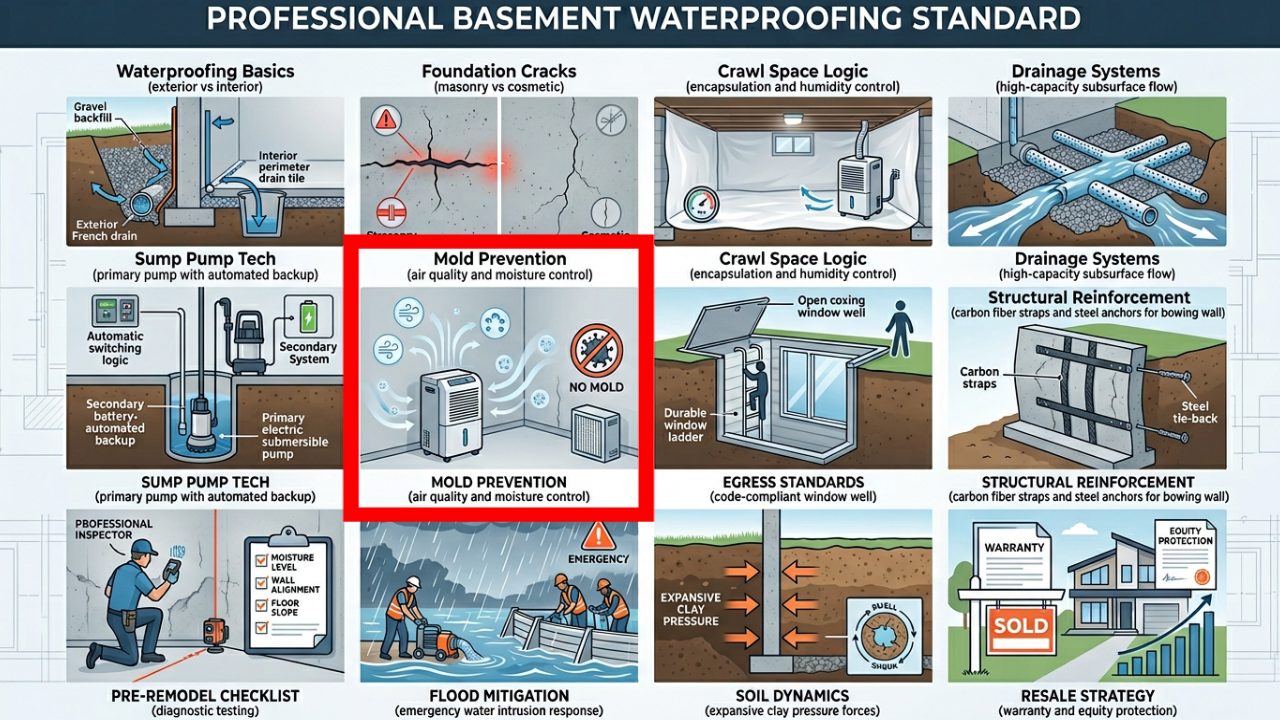
The Legacy “Cleaning” Approach
Traditional methods focus on reacting to visible growth. In below-grade environments, topical treatments rarely reach the source of the infestation.
- ✗Bleach & Scrubbing: Kills surface spores but leaves hyphae (roots) alive in porous masonry.
- ✗Ignoring Humidity: Fails to address the high moisture levels that fuel recurring growth.
- ✗Reactive Strategy: Waiting for visible signs before treating a biological problem.
The Professional Standard
Industrial-grade prevention focuses on mechanical environment stabilization and creating structural surfaces that are naturally hostile to mold.
- ✓Mechanical Dehumidification: Maintaining RH levels strictly below 50% to stop growth.
- ✓Antimicrobial Coatings: Barriers that prevent spores from attaching to structural surfaces.
- ✓Air Quality Protection: Using the Stack Effect to push clean, dry air throughout the home.
The Biology of Foundation Decay
Mold is a biological reality wherever moisture, warmth, and organic food (wood framing, drywall, dust) meet. A professional prevention strategy is, in reality, a whole-home respiratory health strategy.
The 50% Rule
Microbial growth effectively ceases when relative humidity is maintained below 50%. Professional systems don't just "dry" the air; they maintain a specific set point to protect the structural integrity of your home's skeletal system.
Whole-Home Air Impact
Because of the Stack Effect, air in the basement or crawl space travels upward into the living areas. By controlling the environment at the foundation level, we prevent contaminants from circulating through your family's breathing air.