Drainage Systems: High-Capacity Subsurface Management
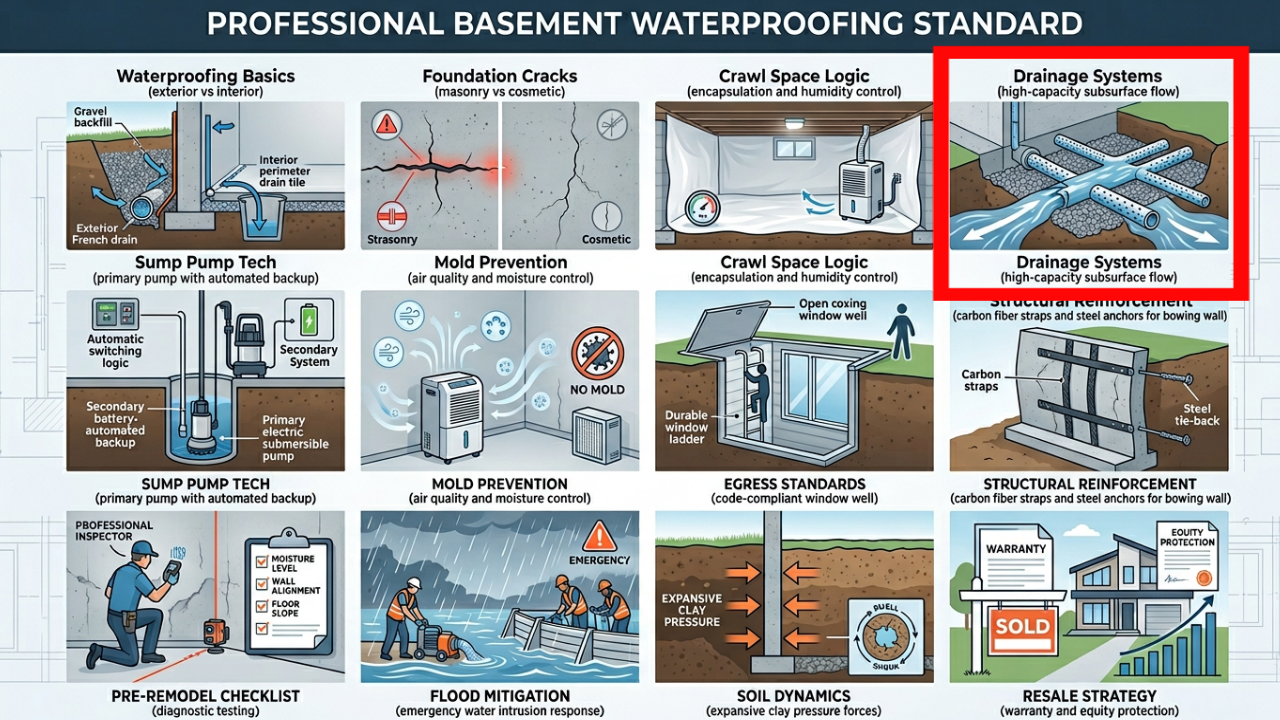
The professional standard for drainage focuses on hydrostatic pressure relief rather than surface water removal. Engineered systems utilize subsurface French drains and perforated high-flow piping to proactively protect the foundation footer.
The Legacy “Landscaping” Approach
Traditional drainage often relies on thin-walled materials and surface-level placement, leaving the foundation vulnerable to deep soil saturation.
- ✗Thin-Walled Piping: Corrugated pipes that easily crush under soil weight or clog with silt.
- ✗Surface Level Only: Drains that manage puddles but leave the foundation footer underwater.
- ✗Retail Filters: Light fabrics that quickly decompose or blind over, stopping water flow.
The Professional Standard
Engineered water management redirects groundwater before it can exert force on the masonry, maintaining a dry, stable environment at the footer level.
- ✓Engineered Aggregates: Using washed river stone to maintain high hydraulic conductivity.
- ✓Footer-Level Placement: Relieving water pressure exactly where the wall meets the floor slab.
- ✓Rigid PVC Design: High-flow, smooth-wall piping that resists compaction and biological growth.
Hydrostatic Pressure Relief
A French drain is not just a pipe in the ground; it is a meticulously designed filter system. When installed correctly, it acts as the path of least resistance for groundwater, bleeding off pressure before it causes seepage.
The Role of Hydrostatic Relief
As soil becomes saturated, it exerts thousands of pounds of pressure against your foundation. Professional drainage systems "bleed" this pressure off before it can cause structural bowing or cracks.
Industrial Materials vs. Retail Grade
The standard relies on rigid, perforated PVC and industrial-strength filter fabrics designed to resist soil compaction. This ensures the system remains functional for the life of the structure.