Flood Mitigation: Immediate Response Protocols
The professional standard for flood mitigation transitions from reactive emergency response to engineered resilience. When local infrastructure fails, your home must act as an independent, dry island.
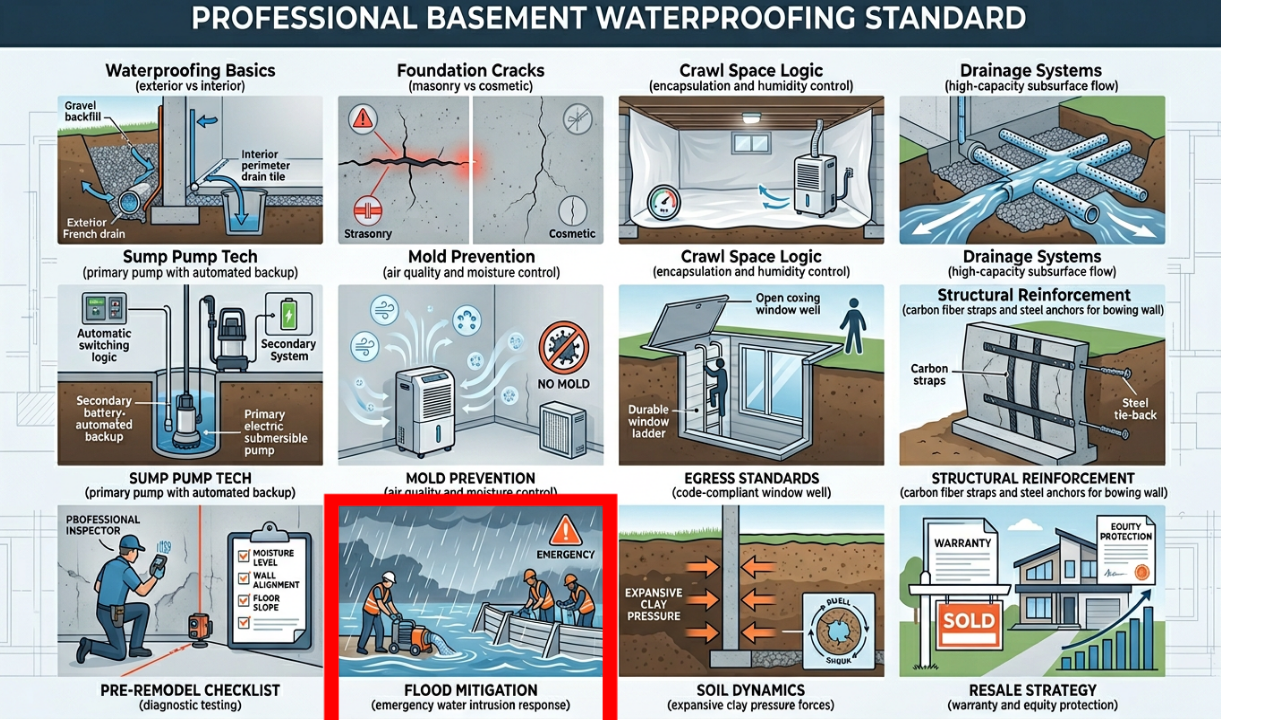
The Legacy “Sandbag” Approach
Traditional methods often focus on external barriers while failing to address the sub-slab pressure buildup or municipal infrastructure failures.
- ✗External Barriers: Attempting to block rising surface water without addressing sub-slab pressure.
- ✗Passive Acceptance: Relying on standard insurance that often excludes groundwater flooding.
- ✗Single Point Failure: Depending on a lone pump without power redundancy.
The Professional Standard
Engineered resilience relies on a multi-staged defense system: high-volume discharge, redundant secondary power, and backwater prevention.
- ✓Backwater Prevention: Check-valves that stop city sewer backup during storm surges.
- ✓High-Flow Discharge: Lines designed for extreme volumes without air-locking or freezing.
- ✓Triple-Redundancy: Fail-safe logic involving primary, secondary, and backup power layers.
Engineering Climate Resilience
A flood event is the ultimate test of a foundation's engineering. A "Standard" protocol ensures your home’s plumbing is a one-way street, keeping municipal surcharges out of your living space.
Managing Municipal Surcharges
During extreme rain, city sewers often become overwhelmed. Without a professional backwater valve, the city's excess water and sewage are pushed backward into your basement.
The Triple-Redundancy Requirement
Professional flood mitigation is built on layers. Layer 1: The primary pump. Layer 2: The high-output backup. Layer 3: Independent power (battery or generator). This fail-safe logic is the hallmark of the Professional Standard.