Arresting Foundation Movement: Carbon Fiber & Steel Anchors
When hydrostatic pressure causes masonry to bow or crack, structural integrity is compromised. The professional standard utilizes lateral tension engineering to stabilize walls and prevent further displacement.
Passive Legacy Methods
Traditional shoring often relies on bulky steel beams that consume floor space and only block movement at specific points without addressing the underlying tension.
- ✗Intrusive I-Beams: Requires heavy drilling into floors and occupies usable square footage.
- ✗Wood Shoring: Temporary measures that rot or shift as soil conditions change.
- ✗Point-Loading: Concentrates stress in specific areas, potentially causing secondary cracking.
The Professional Standard
Modern reinforcement uses aerospace-grade materials and torque-monitored anchors to provide distributed strength and potential wall recovery.
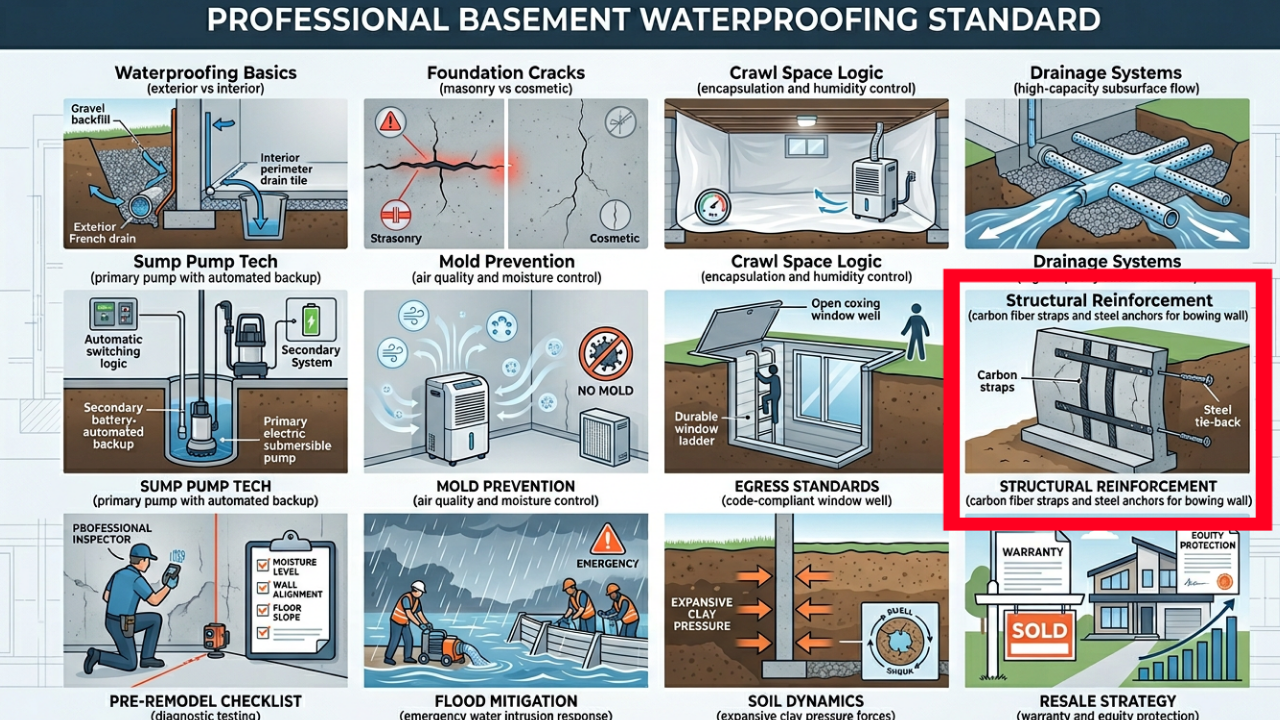
- ✓Carbon Fiber Straps: High-tensile polymers that bond to the wall, providing 10x the strength of steel.
- ✓Steel Tie-Backs: Threaded rods reaching into stable soil to pull bowing walls back toward verticality.
- ✓Low Profile: Systems can be painted over or finished, preserving the basement's living space.
The Engineering of Stability
Structural reinforcement is not just about "holding" a wall; it's about counteracting thousands of pounds of external pressure. Professional systems are designed to arrest movement immediately and protect the home's long-term resale equity.
Why Carbon Fiber is the Gold Standard
Carbon fiber reinforcement is non-corrosive and does not stretch. Once epoxy-bonded to the foundation, it effectively creates a "structural cage" that prevents masonry from expanding or cracking under lateral soil loads.
Active Recovery with Wall Anchors
Unlike passive systems, engineered wall anchors can be tightened over time. This allows a professional to gradually "recover" a bowing wall, potentially returning displaced masonry back to its original vertical alignment.